Navigating Identity, Ambition, and Belonging as a Young Muslim
It’s easy to feel stretched between different responsibilities when you finish a long day of classes or work, check your phone, and find yourself surrounded by constant updates about what others are achieving.
You’re trying to:
- Perform well in your studies
- Build a career
- Maintain your prayers
- Meet the expectations of your family
All while figuring out the person you want to become. These pressures create difficult questions for many young Muslims. The most common muslim youth challenges often involve balancing personal ambitions with religious values, navigating social expectations, and staying grounded in a world filled with competing influences.
Finding clarity begins with understanding what is the purpose of life according to Islam. When you understand what your efforts are ultimately directed toward, your education, career goals, and daily choices gain a deeper sense of direction.
In this read, we explore the challenges young Muslims face today, the importance of building a confident Muslim identity, and how faith can guide you toward a future shaped by purpose, responsibility, and meaningful contribution.
As you move through university, work, and new social environments, your beliefs often meet situations that require reflection and confidence. You may encounter different perspectives, expectations, and lifestyles that challenge how you understand yourself and your values.
These moments can shape some of the most important questions of young adulthood:
- How do I remain connected to my faith while engaging with different environments?
- How do I pursue success without losing sight of my purpose?
- How do I make decisions that respect both my responsibilities and my values?
These questions are at the heart of many muslim youth challenges today. They appear in different areas of life, from education and career choices to family expectations, social influences, and personal direction.
Understanding these challenges is the first step toward building a confident identity rooted in faith, knowledge, and purpose. These challenges can appear in different ways:
| Challenge | What It Can Feel Like |
| Different Values and Perspectives | Encountering ideas that challenge your beliefs and trying to respond with confidence and understanding |
| Pressure to Succeed | Measuring yourself through achievements, comparison, and external expectations |
| Family and Personal Direction | Balancing respect for your family with discovering your own strengths and goals |
| Too Many Choices | Feeling uncertain about decisions related to education, career, and the future |
Building Confidence in Your Muslim Identity
A strong Muslim identity grows through understanding, reflection, and conviction. Many young Muslims begin their faith journey through the traditions and practices they inherit from their families.
As they enter universities, workplaces, and wider communities, they naturally begin asking deeper questions about their beliefs and values.
This process is an important part of personal growth. Moving from inherited practices toward conscious understanding allows your faith to become a source of confidence and direction.
Finding Dignity Through Your Relationship With Allah
Your value is not defined only by:
- Achievements
- Social recognition
- How others perceive you.
Islam teaches that human dignity comes from the relationship between the Creator and His creation. When your sense of worth is connected to Allah, external pressures become easier to navigate. Success, failure, praise, and criticism no longer define your entire identity because your purpose is rooted in something deeper.
Moving From Habit to Understanding
Faith becomes stronger when it is supported by knowledge and reflection. Asking questions, learning from reliable sources, and understanding the wisdom behind Islamic teachings help you develop a more confident relationship with your faith.
A young Muslim who understands why they believe can carry their values with greater clarity, whether they are studying, working, or interacting with people from different backgrounds.
Living Your Values With Confidence and Humility
Confidence in your faith does not require isolation from others. It means carrying your values with respect, wisdom, and good character. It can appear in everyday choices:
- Maintaining your prayers while managing academic or professional responsibilities.
- Making ethical decisions even when shortcuts appear easier.
- Treating others with kindness while remaining committed to your principles.
Developing a confident Muslim identity means allowing your faith to guide your values, strengthen your character, and influence how you engage with the world.
The Role of Youth in Islam: Responsibility Beyond Age
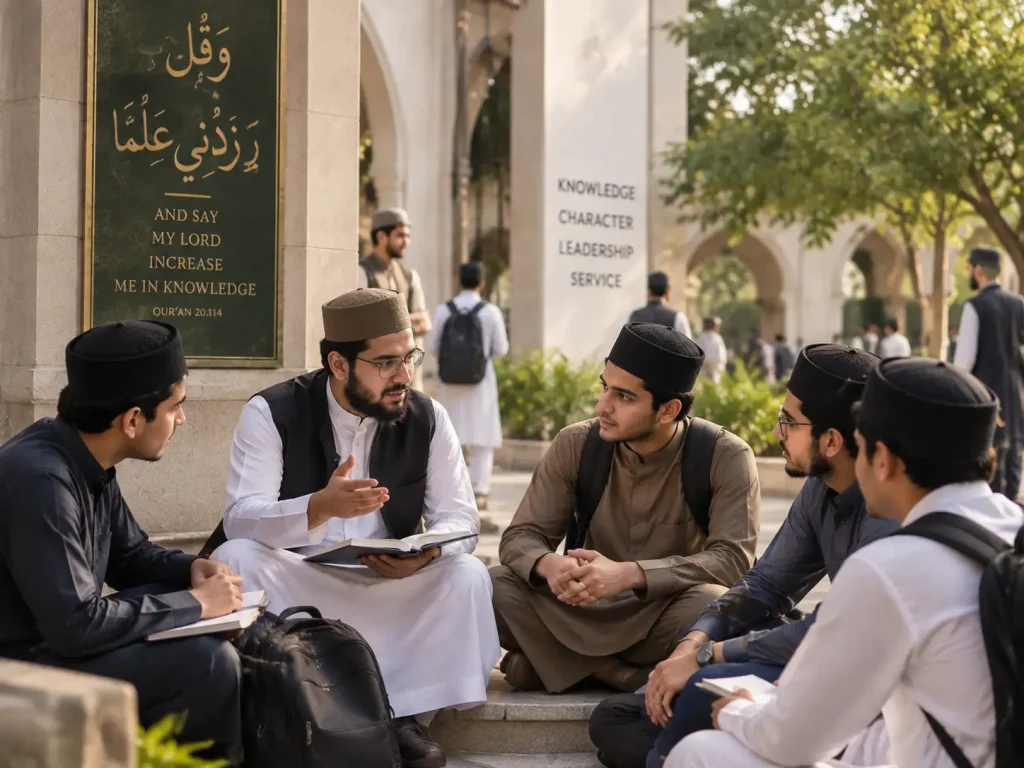
Islam recognizes youth as a stage filled with energy, learning, responsibility, and opportunities for contribution. The choices you make during these years can shape not only your own future but also the people and communities around you.
The Prophet Muhammad (PBBUIH) said:
“Seven are those whom Allah will give shade on the Day when there is no shade but His…a young person who grew up in the worship of Allah.” – (Riyad as-Salihin 449)
This hadith highlights the value of dedicating your youth to a meaningful relationship with Allah.
The Prophet (PBUH) also reminded us that every stage of life carries responsibility:
“The feet of the son of Adam will not move on the Day of Judgment until he is asked about four things…about his youth and how he used it…” – (Jami` at-Tirmidhi 2417)
Your youth is a time of action, learning, and contribution. The knowledge, energy, and abilities you develop today can already create meaningful change around you. Islamic history provides examples of young people carrying significant responsibilities:
- The Companions of the Cave (Ashab al-Kahf):
The Quran describes them as young people who believed in their Lord and remained firm in their principles:
“Indeed, they were youths who believed in their Lord, and We increased them in guidance.” – (Surah Al-Kahf 18:13)
- Mus’ab ibn ‘Umayr:
A young companion entrusted with teaching Islam in Madinah and preparing the community through knowledge and character.
- Usama ibn Zayd:
Appointed by the Prophet (PBUH) to lead an army while still very young, showing that responsibility is connected with capability and character.
Understanding the role of Muslim youth in the Ummah gives greater purpose to your personal journey. The knowledge you gain, the skills you develop, and the ambitions you pursue can become a means of creating benefit beyond yourself.
Navigating the Digital World With Purpose
Digital technology has transformed how young people learn, communicate, and build their futures. At the same time, constant exposure to online content can make it difficult to protect your attention and maintain clarity about what truly matters.
When you spend hours comparing your progress with carefully presented versions of other people’s lives, it becomes easy to overlook your own growth. Achievements, lifestyles, and opinions appear constantly on your screen, creating pressure to measure your worth through external validation.
Building a healthy relationship with technology requires conscious choices:
| Digital Habit | Impact on Your Growth |
| Endless scrolling | Reduced focus and mental fatigue |
| Constant comparison | Less gratitude and self-confidence |
| Online arguments | Emotional exhaustion and weakened character |
| Passive consumption | Less time for meaningful action |
Strengthening your Muslim identity in the digital age requires awareness of how you use your attention:
- Move From Consumption to Creation:
Use technology as a tool for learning, developing skills, sharing beneficial knowledge, and creating solutions that help others.
- Protect Your Attention and Character:
Islamic teachings emphasize guarding your eyes, words, and actions. Choosing what you engage with online protects both your mental focus and spiritual well-being.
- Create Time Away From Screens:
Setting intentional moments away from devices allows you to reconnect with yourself, your family, and your responsibilities.
Your attention is one of your most valuable resources. Protecting it allows you to build habits that support your faith, personal growth, and purpose.
Building Daily Practices That Strengthen Resilience

Faith becomes stronger when it is reflected through consistent actions. Small daily choices shape the way you manage your time, respond to challenges, and stay connected to your values.
Three practices can help create greater balance in your everyday life:
1. Build Your Day Around Salah
Prayer provides natural moments of reflection throughout the day. Instead of fitting Salah into the remaining gaps of your schedule, allow it to become an anchor around which your studies, work, and responsibilities are organized.
These pauses create moments to reset your intentions and reconnect with Allah.
2. Choose Relationships That Strengthen You
The people around you influence your priorities, habits, and outlook. Building friendships with individuals who encourage growth, sincerity, and responsibility helps you remain focused during challenging periods.
Good companionship provides reminders, support, and motivation when you need it most.
3. Connect Your Skills With Meaningful Contribution
Your education and career can become expressions of purpose when they are guided by good intentions.
A student developing technology, a doctor caring for patients, an entrepreneur creating ethical businesses, or a professional solving problems for society can all transform their work into meaningful contribution.
Developing these qualities helps you build the foundations of Islamic leadership qualities in your personal and professional life.
From Personal Growth to Collective Responsibility: Faith & Future Summit 2026
Personal growth becomes more meaningful when it connects with the people and communities around you.
Questions about identity, purpose, and contribution require reflection and meaningful conversations. The Faith & Future Summit 2026, centered around the theme “Beyond Self: A Vision for the Ummah,” brings together scholars, educators, and young individuals to explore how faith can guide personal development and collective responsibility.
Jointly organized by the School of Islamic Scholars & Leaders (SISL) and Al-Kawthar University, the summit takes place on Sunday, 20 September 2026, at the Al-Kawthar University Auditorium in Karachi.
The keynote sessions explore important questions facing young Muslims today:
- Sheikh Hussain Yee: “What Will Outlive You?”
Exploring how your time, skills, and ambitions can be directed toward work that continues benefiting others beyond your own lifetime.
- Sheikh Kashif Naseem Dilkusha: “From ‘Me’ to ‘We’: Reviving the Ummah’s Collective Spirit”
Discussing how young Muslims can move from individual achievement toward cooperation, service, and shared responsibility.
Through these discussions, young Muslims can reflect on their direction, learn from experienced voices, and consider how their personal growth can contribute to a wider purpose.
Transforming Potential Into Meaningful Impact
The challenges faced by young Muslims today require clarity of purpose, strong character, and a deeper understanding of how faith shapes the way we live, learn, and contribute.
Your youth is a time of immense potential. The knowledge you gain, the skills you develop, and the ambitions you pursue become more meaningful when they are guided by faith and connected to a purpose greater than personal achievement.
Finding that direction requires reflection, learning, and conversations that help you understand how your beliefs influence your choices and your vision for the future. This is the foundation behind the Faith & Future Summit 2026 and its theme, “Beyond Self: A Vision for the Ummah.”
The summit brings together scholars, educators, and young individuals to explore questions of identity, purpose, leadership, and responsibility in a changing world. It encourages you to reflect on the person you are becoming and how your growth can create meaningful impact beyond yourself.
Because personal growth reaches its highest purpose when it transforms into positive contribution.
Frequently Asked Questions About Muslim Youth Challenges
How can a young Muslim overcome doubts about their faith?
Questions about faith can become an opportunity for deeper understanding. Learning from reliable sources, asking sincere questions, and building knowledge gradually strengthens your connection with Islam. Faith grows through reflection, learning, and consistent effort.
How can young Muslims handle pressure from friends or social environments?
Maintaining your values becomes easier when you understand why those values matter. Approach others with kindness while remaining confident in your choices regarding prayer, lifestyle, and personal boundaries.
Can career ambition and Islamic values exist together?
Professional excellence and Islamic values can work together when ambition is guided by ethical principles and sincere intentions. Developing skills, earning responsibly, and creating benefit for others are meaningful ways to use the abilities Allah has given you.
How can young Muslims deal with loneliness?
Meaningful relationships require more than online interaction. Building connections through family, community involvement, learning circles, and service creates stronger bonds based on shared values.
How should Muslims approach modern culture?
A thoughtful Muslim engages with the world through understanding and wisdom. Beneficial knowledge, innovation, and positive contributions can be embraced while remaining committed to Islamic principles.